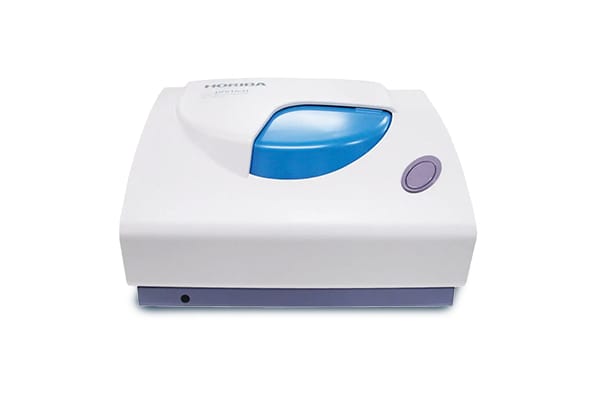
HORIBA SZ-100V2 Nanoparticle Analyzer
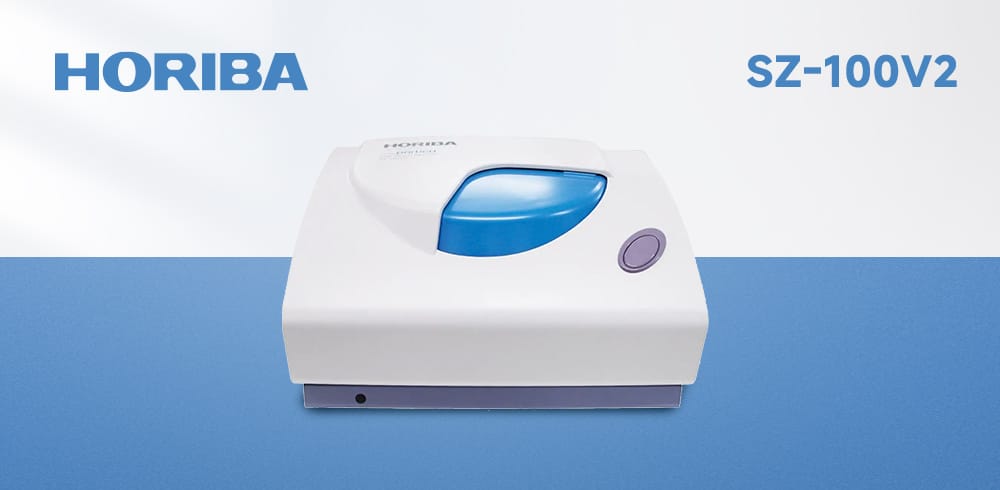
HORIBA SZ-100V2 Nano Particle Analyzer Product Introduction:
A compact and streamlined device capable of simultaneously characterizing three key parameters of nanoparticles: particle size, zeta potential, and molecular weight.��。
The development of nanotechnology is an ongoing process that involves controlling matter at the molecular and atomic levels to create new, superior, and advanced materials and products. To achieve efficient, high-performance products while reducing energy consumption, HORIBA introduces the SZ-100V2 Nanoparticle Analyzer. This instrument enables multi-parameter analysis of nanoparticles through simple operation! It delivers precise nanoparticle size measurements and dispersion stability with straightforward technology, opening the door to your advancement in nanotechnology!
HORIBA SZ-100V2 Product Features of the Nanoparticle Analyzer:
Particle size measurement range: 0.3 nm to 10 μm
The SZ-100V2 series employs dynamic light scattering (DLS) to measure particle size and distribution, enabling accurate measurements across an exceptionally wide concentration range—from parts per million (ppm) to concentrations as high as several tens of percent. It is compatible with commercially available sample cells and facilitates convenient measurement of trace samples.
Zeta potential measurement range: ?500 to +500 mV
Using HORIBA's micro-sample cell requires only 100 μL of sample. The stability of dispersed systems can be predicted and controlled through zeta potential values. Higher zeta potential indicates greater stability in dispersed systems, which is highly significant for formulation research.
Molecular measurement range 1×10³ ~ 2×10⁷
By measuring the static scattering intensity of samples at different concentrations and calculating the absolute molecular weight (Mw) and second-Villi coefficient (A2) via the Debye notation method.
HORIBA SZ-100V2 The intelligent and learning capabilities of the nanoparticle analyzer enable rapid determination of nanoparticle characteristics�����!
The SZ-100V2 series offers a wide measurable sample concentration range, eliminating the need for sample dilution or other preparatory steps. Its unique dual-beam optical path system (90° and 173°) enables measurement of both high-concentration samples, such as glaze slurry and pigments, and low-concentration samples, including proteins and polymers.
Integrates the measurement of three key parameters characterizing nanoparticles: particle diameter, zeta potential, and molecular weight.。
HORIBA's disposable zeta potential measurement sample cells eliminate sample contamination. The dedicated ultra-micro sample cells (minimum capacity 100 μL) are simple to use and suitable for analyzing diluted samples.���。
HORIBA's dedicated graphite electrode for zeta potential measurements is suitable for analyzing highly saline samples with strong corrosive properties.�。
HORIBA SZ-100V2 Measurement Principle of Nanoparticle Analyzer:
Principle of Particle Size Measurement
The HORIBA SZ-100V2 Nanoparticle Analyzer employs dynamic light scattering technology to measure particle size by detecting fluctuations in the intensity of scattered light over time. The Brownian motion of nanoparticles causes variations in light intensity, and statistical analysis of these fluctuations can be correlated with particle diffusion. Since the intensity of Brownian motion is significantly correlated with particle size, a relationship can be established between particle size and the fluctuations in scattered light intensity.
Principle of Zeta Potential Measurement (Laser Doppler Electrophoresis Method)
Most nanoparticles and colloidal particles suspended in a liquid carry surface charges. When an electric field is applied to the liquid, the charged particles move under the influence of the electric field. The direction and velocity of this motion depend on the particle's charge, the dispersion medium, and the electric field strength. By observing the Doppler shift in scattered light, the particle's velocity can be measured. This velocity is proportional to the potential across the particle's shear plane (i.e., the zeta potential). Therefore, the particle's zeta potential can be determined by measuring its motion under an electric field.
Principles of Molecular Weight Measurement
The HORIBA SZ-100V2 Nanoparticle Analyzer employs two methods to measure the molecular weight of macromolecules such as polymers, proteins, and starches. The first method utilizes particle size information obtained through dynamic light scattering and the Mark-Houwink equation. The second method is the Debye notation.
HORIBA SZ-100V2 Nanoparticle Analyzer Primary Applications:
Semiconductor: | CMP |
功能納米材料: | carbon nanotube |
Advanced Carbon Materials |
Nano-cellulose |
Pigments, Inks: | Pigments, fuels |
Toner suspension |
Energy: | Battery Materials |
HORIBA SZ-100V2 Nanoparticle Analyzer Accessory Options:
Sample Pool
Disposable sample cell | Semi-micro pool | Glass Pool | Disposable Semi-Micro Pool | Sample Chamber (with Lid) |
Micro-pool (side detection only) | Submicron Pool | Flow Pool | Zeta Potential Plastic Cell | Zeta Potential Glass Cell |
Automatic Titrator
It enables automatic pH titration during Zeta potential or particle size measurements, making it an ideal choice for isoelectric point determination.
HORIBA SZ-100V2 Nanoparticle Analyzer Product Specifications:
Measurement Principle | Particle Size Measurement Principle: Dynamic Light Scattering Method Principle of Molecular Weight Measurement: Debye Counting Method (Static Light Scattering Method) |
Measurement Range | Particle size: 0.3 nm to 10 μm Molecular weight: 1000 to 2 × 10? Da (Debye notation) 540 to 2 x 10⁷ Da(MHS Formula) |
Maximum Sample Concentration | 40 wt% |
Measurement angle | 90° And173° |
For additional specifications, please contact us. |
HORIBA SZ-100V2 Nanoparticle Analyzer Measurement Case Study:
Biomaterials: Colloidal Gold Particle Size Measurement Results
NIST) | RM8011 | RM8012 | RM8013 |
Nominal diameter(nm) | 10 | 30 | 60 |
NIST diameter (nm) measured by the DLS method | 13.5 | 26.5 | 55.3 |
Diameter measured by SZ-100 (nm) | 11.0 | 26.6 | 55.4 |